Meet Zoom AI Companion, your new AI assistant!
Boost productivity and team collaboration with Zoom AI Companion, available at no additional cost with eligible paid Zoom plans.
 11 min read
Updated on March 16, 2026
Published on March 16, 2026




A lot goes into running a thriving contact center, like resolving customer issues, end-of-call wrap-ups, answering customer questions, and agent training. Fortunately, technology is advancing rapidly, and artificial intelligence (AI) is paving the way for call centers to become more efficient and better serve customers.
Zoom’s State of AI in Customer Experience (CX) 2025 report reveals that 64% of companies that are using AI for call centers enjoy a positive ROI, while 79% say AI is tackling more complex problems for them now than it was a year ago.
Here, you’ll learn more about what artificially intelligent contact centers are and what features they provide. We’ll also go over some of the best use cases for AI in call centers to improve customer satisfaction and retention.
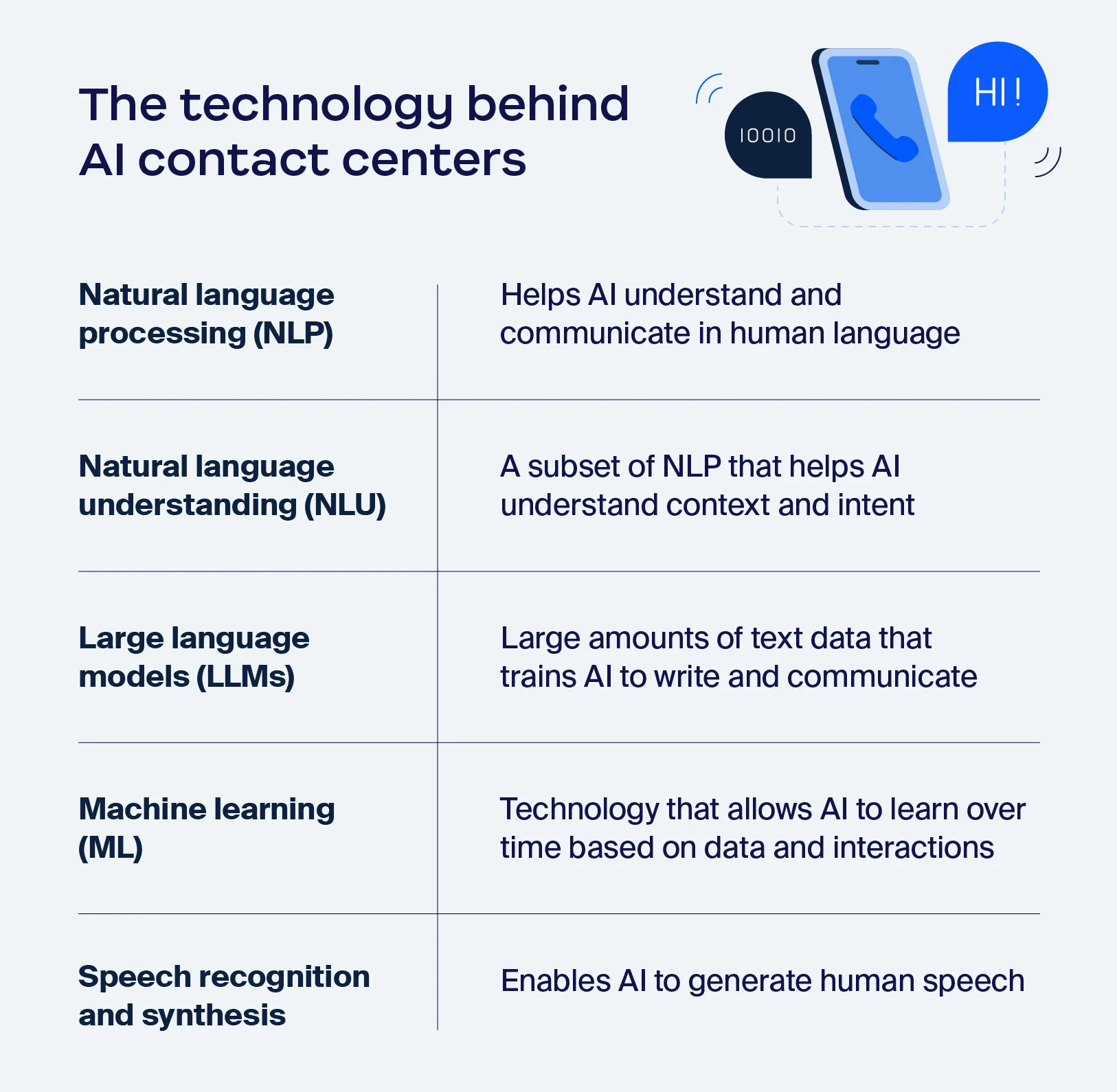
An AI contact center combines human support with AI systems built on large language models (LLMs). These models read and interpret conversations to then generate responses or suggestions based on patterns learned from massive volumes of real interactions.
AI call center technology gives agents helpful context in the moment to resolve customer issues more effectively. This may explain why a projected 80% of customer service organizations use it to improve agent productivity, according to recent call center statistics. In this setup, automated agents can manage common questions and route conversations. In contrast, human agents can deal with nuanced situations that require empathy or judgment beyond what AI systems can provide.
A misconception is that AI will replace agents. In reality, it’s meant to assist the entire call center team with an assortment of tasks.
AI provides contact centers with solutions to improve internal workflows, administrative tasks, and much more. But how does it all work? Below, we provide a brief overview of the technology used in AI contact centers:
These features give your contact center AI capabilities to help improve productivity and customer service from day one.
There are some technical differences between AI call centers and AI contact centers, but the terms are often used interchangeably.
AI contact centers can be multichannel or even omnichannel, meaning they can support communication beyond just calling, including chatbots, video chat, text, email, and more. AI call centers use AI technology exclusively to support call handling.
CCaaS platforms now offer chatbots and virtual agents to engage customers, as well as agent-assist features such as Next Best Action, Auto Translation, and Automatic Wrap-Up.
In the long run, an artificial intelligence call center can speed up resolutions and create more consistent experiences across all channels. Since these systems learn from past conversations, their recommendations also improve over time.
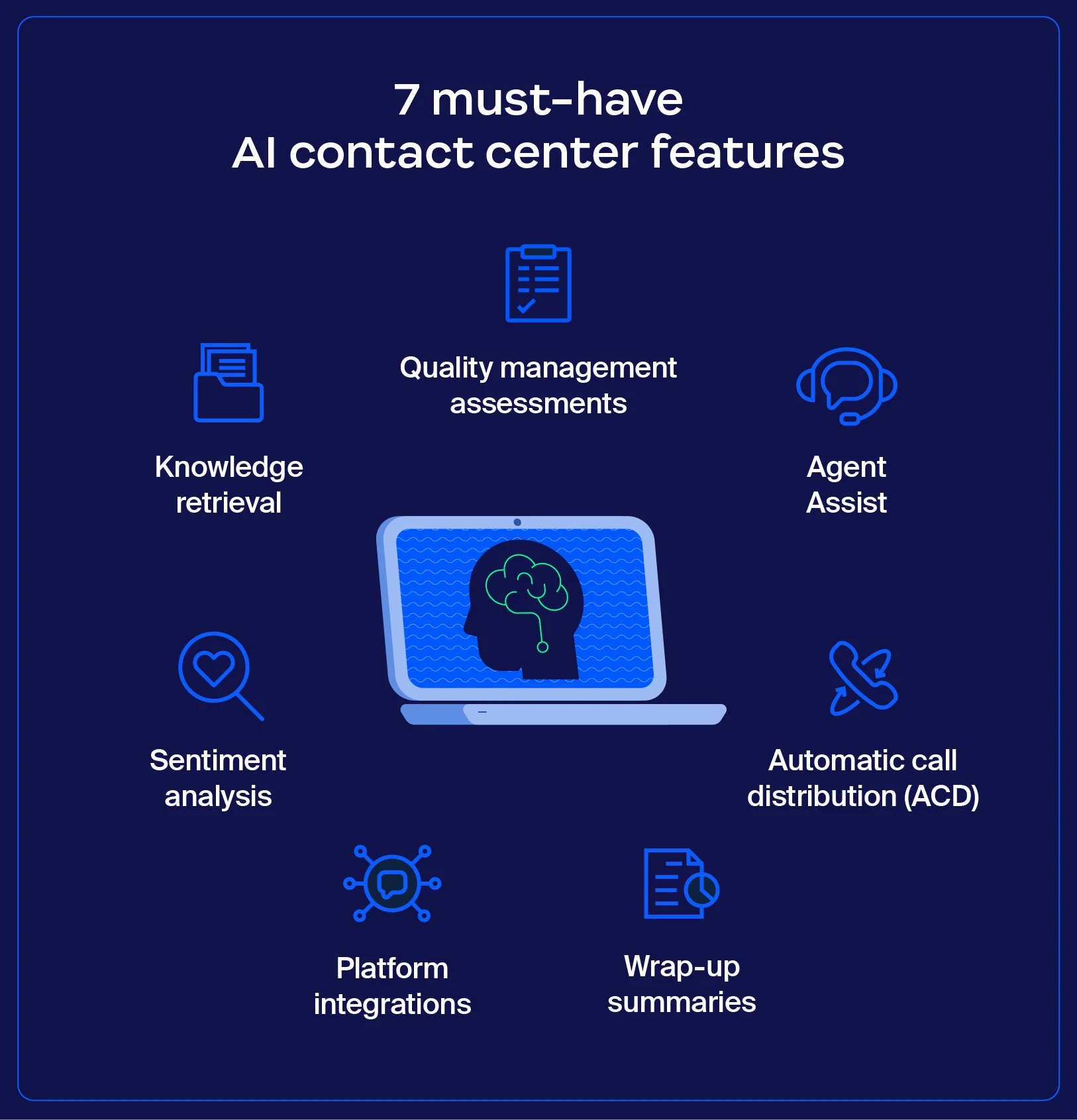
AI contact center software provides a wide range of useful features to assist call center agents, managers, and customers. Understanding these features is helpful to employ this technology in your call center.
Quality management is an integral part of running a successful call center because quality managers can provide valuable feedback to agents, like the best way to de-escalate a call. Unfortunately, due to the number of calls that come through a call center on any given day, it’s unrealistic for quality managers to review each call individually.
AI can help contact centers with quality management by combing through entire call transcripts and creating simplified summaries with suggestions for improvement. This gives quality managers more time to focus on coaching agents rather than reviewing calls, and it’s so effective that 66% of call center supervisors report improved quality management as of 2024.
Agent assistance supports live agents during customer conversations by listening and analyzing context to offer guidance in real time. This feature, powered by LLMs, can suggest responses or appropriate next steps without interrupting the call’s flow. Using this tool, the agent can stay focused and reduce manual lookups and after-call work.
Suppose a customer calls about a billing dispute that includes multiple products. As the conversation goes on, the agent assist picks up on key phrases and pulls related policies. It then suggests a clear explanation that the agent can adapt how they see fit. Plus, it can prompt the agent to ask follow-up questions or summarize the interaction for later use.
Adoption is picking up quickly, with 64% of companies already using this feature or having plans to use it in 2025. Organizations using it report 64% greater employee efficiency, 60% reduced costs (alongside 49% higher revenue growth), and 39% better CSAT scores.
Zoom’s AI Expert Assist provides a strong example of an AI assistance tool. It offers real-time guidance during live conversations, surfaces relevant knowledge, and helps agents respond more efficiently without putting customers on hold.
Automatic call distribution (ACD) is the technology that matches the customer with an agent who has the unique skills to help them. For example, you may have bilingual agents who can communicate in different languages or have expertise in specific areas. With ACD, AI can assess what the customer needs and direct them to the agent best suited to meet those needs, saving time and providing the customer with a better experience.
ACD isn’t just for directing calls, either. An AI contact center has routing capabilities that integrate with all of your communication channels. Whether a customer calls, emails, or texts, the AI can direct them to an available agent with the best skills for the situation.
After each call, agents write wrap-up summaries to recap what happened on the call. This helps the next agent who works with the customer know where the last agent left off. While these summaries are necessary, writing them by hand takes up time that the agent could spend helping the next customer.
AI can decrease the time needed for this task by generating a summary of each call once it’s complete. According to a 2024 report from Metrigy and Zoom, generative AI summarizations help agents save 35% after-call time. Previously, agents spent 16.2 minutes on summary generation, which AI helped reduce to 10.4 minutes. Then the agent simply needs to review it for accuracy before moving on to the next customer interaction. With this Zoom CX feature, we’ve seen a 50% decrease in time spent on wrap-up summaries for customers.
Call centers use a variety of platforms, such as CRMs, knowledge bases, and ticketing systems. Whenever you adopt a new form of technology, you want to be sure it works seamlessly with the platforms you’re already using. AI contact centers provide that functionality.
AI contact center software often integrates with popular CRM platforms. Whether it’s Salesforce, Zendesk, or PCI Pal, you can set up your AI contact center to work with them and utilize valuable tools like wrap-up summaries and agent assist.
Sentiment analysis is the technology that enables AI to understand how customers feel when they call by analyzing context and tone.
During a conversation, sentiment analysis can alert the agent if a customer is becoming upset in real time. It can then provide the agent with information and suggestions via agent assist. This can also help with detailed wrap-up summaries and quality management by informing you of the customer’s mood throughout an interaction.
Knowledge retrieval is the contact center’s ability to search for information across sources such as previous calls, standard operating procedures, and FAQs to help agents answer questions quickly. This feature helps limit the need to put customers on hold, keeping them happy and reducing frustration.
AI can also power contact centers with chatbots that answer simple customer questions. Knowledge retrieval helps chatbots answer a broader range of questions, freeing agents to work with customers who require a human touch.
The use cases for AI contact centers are wide-ranging. Below, we go over some everyday situations where this technology can benefit your call center.
Analytics are essential to any business, and AI can help efficiently and effectively organize and analyze data. For example, AI can measure your KPIs, like average call time, and provide key insights. Reporting data could show management that the average call time is down because customers are switching to chatbots rather than calling.
Once you have your contact center software set up, you can customize it to run reports on the metrics important to your situation.
Contact center artificial intelligence software also tracks call volume, which can help with workforce management. Every call center has busy and slow seasons. When creating schedules, you don’t want to be overstaffed during slow times or understaffed during your peaks, and AI can help prevent this.
An artificial intelligence contact center can monitor historical call volumes and provide you with valuable scheduling data. Not only can this help you properly staff your call center for effective customer care, but it can also help keep employees from feeling overwhelmed due to understaffing.
It’s no secret that customers can get frustrated; that’s just the nature of customer service. In fact, according to Zoom’s new survey, Discover why Gen X is less brand-loyal than Gen Z: 63% of Gen Z customers bid farewell to brands after one or two bad experiences. Although agents are trained to de-escalate calls, sometimes they don’t have the answers, so they place the customer on hold and find a supervisor. This can frustrate the customer even more and take up the supervisor’s time.
Sentiment analysis can also help provide agents with suggestions to de-escalate the situation. The AI-powered contact center is trained on your operating procedures, knowledge base, previous conversations, and much more. Agents then quickly receive suggestions that can help the customer without having to put the customer on hold.
Customers want their issues resolved quickly, and many prefer to find the answer on their own rather than make a call or contact an agent through other communication channels. With AI self-service, chatbots can handle many of your customers’ common questions by pulling from your entire knowledge base.
Whether your customers need help during unstaffed business hours or during the day, the AI chatbot can help. This frees agents to handle more complex issues that require human assistance. The improvement in customer satisfaction is already evident among organizations using AI call center solutions, with 76% reporting a 31% increase in customer ratings, according to Zoom’s State of AI in CX 2025 report.
As we’ve covered, a primary benefit of AI contact centers is workforce management, which helps reduce costs by preventing overstaffing during slower periods. These advanced systems integrate with many other platforms, but they can also reduce your spending on different software products.
AI-powered contact center software has such a wide range of features that it may replace other tools in your stack, saving your company from other monthly or annual fees. On average, using artificial intelligence for call centers has reduced costs by 21% for over half of the organizations.
Based on customer experience statistics, around 60% of customers say a single negative experience is enough for them to consider a competitor. This isn’t something SMEs can afford, which means CX efficiency needs to be a top priority.
AI contact centers make agents more efficient by finding answers for customers and generating wrap-up summaries. Nearly 63% of organizations have seen a 30% increase in employee efficiency with AI usage. Contact centers also make life easier for supervisors and quality managers by providing information that allows them to spend more time helping agents improve their day-to-day tasks.
AI in contact centers also reduces behind-the-scenes work that slows teams down. It can automatically tag interactions and show trends across conversations. For example, it may show you that customers are repeatedly having issues with a specific feature or have queries about a particular subscription plan.
In each area, AI contact centers save time and allow staff to focus on more important tasks, helping the call center thrive. More importantly, AI in contact centers improves productivity since processes are inherently more effective. This is why 42% of call centers are already using AI to boost productivity. Over time, an artificial intelligence call center can keep teams focused on higher-value work, ultimately maximizing efficiency.
ACD enables AI contact centers to connect customers with agents who speak their language, but it can also do much more. AI can translate in real time. For example, a Spanish-speaking customer can use your chat to speak with an English-speaking agent. Using the chatbot, the agent will see English text, and when they respond, the customer will see Spanish text.
This kind of real-time translation also improves business communication by helping to bridge language barriers. CX teams can support more customers without increasing language-specific staffing.
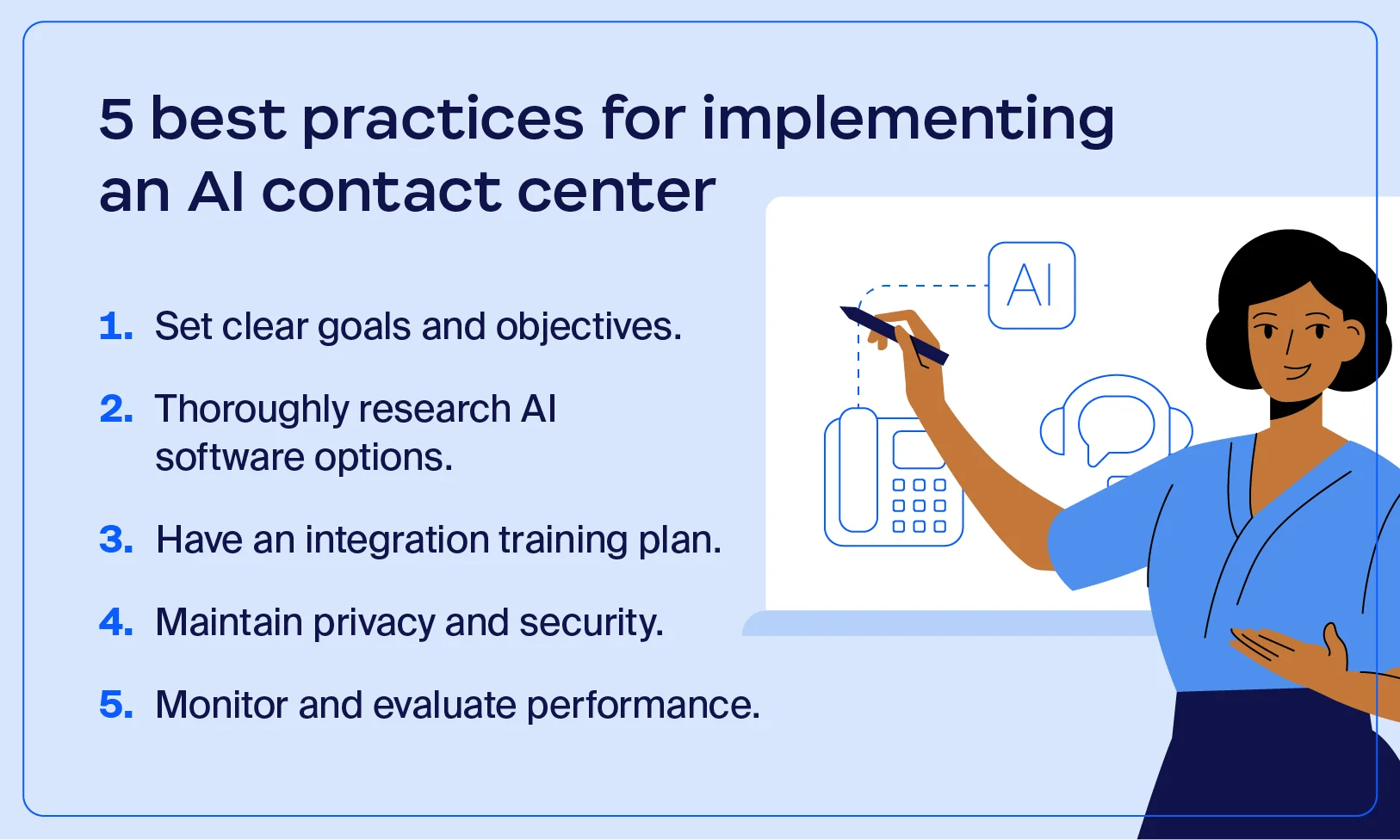
Getting started with an AI contact center can feel overwhelming, but you can make the process more seamless by following our best practices.
An AI contact center can help propel your call center to the next level by increasing efficiency, improving the customer experience, and supporting your staff.
Zoom CX uses advanced AI technology, including sentiment analysis, Agent Assist, and ACD. It also integrates with popular platforms like Salesforce and Zendesk. To learn more about how Zoom CX can help your business, request a demo today.