



Meet Zoom AI Companion, your new AI assistant!
Boost productivity and team collaboration with Zoom AI Companion, available at no additional cost with eligible paid Zoom plans.
Explore the latest small business tech trends in areas like artificial intelligence and hardware innovation to keep your business ahead of the curve.
 9 min read
Published on December 19, 2025




Between increased competition and changing customer expectations, every small business needs to evolve to maintain a competitive edge. Embracing new technology for small businesses is one way to do that, and according to Unified communication platforms, AI tools are changing how we work.
In fact, McKinsey's 2025 AI in the workplace report found that an overwhelming 99% of small and medium-sized business leaders are familiar with using or experimenting with AI. We explored recent data, conducted our own research, and consulted our in-house experts to round up the top small business tech trends as we enter 2026.
AI adoption has grown rapidly over the past few years for both employees and leaders. According to GTIA's 2025 SMB Technology and Buying Trends Report, 63% of SMB respondents say AI will have the greatest impact on their businesses over the next two years. For many SMBs, that impact is tied directly to practical business goals, such as using agentic AI to improve the customer experience and operational efficiency.
This makes agentic AI one of the emerging small business trends many are looking forward to exploring. Instead of simply generating responses or insights, agentic AI tools can automate tasks and workflows across the workplace. AI tools like Zoom AI Companion, for example, can analyze vast amounts of data to:
Our research found that 84% of leaders believe that AI has had a positive effect on their organization's productivity. AI tools, such as those used for automation, decision-making, and other time-saving tasks, can boost business productivity.
We're seeing that play out in practice: More than half of SMBs (53%) are already using AI, and another 29% plan to start by 2026, with most pointing to faster growth and clear ROI within the first year.
"SMBs aren't waiting on the future — they're consolidating now. As AI gets cheaper and closer to the workflow, the real wins come from platforms that turn intent into action: book the meeting, route the call, draft the follow-up. The next wave will make this even more accessible, with smarter defaults and governance baked in."
— Paul Celis, Product Marketing Manager, Small and Midsize Business at Zoom
For AI-forward SMBs/solopreneurs, 98% say AI is essential to growth, and 81% say it plays a critical/major role. 91% report ROI within a year, with benefits like:
"Small businesses are simplifying by choice. When the tools work together, teams spend less time juggling apps and more time serving customers — that's the shift we're seeing."
— Paul Celis, Product Marketing Manager, Small and Midsize Business at Zoom
Despite advancements in small business technology like AI, there's still a strong need for human involvement in customer service. AI can handle certain tasks, but it can't fully replace the empathy and understanding that humans bring to customer experience.
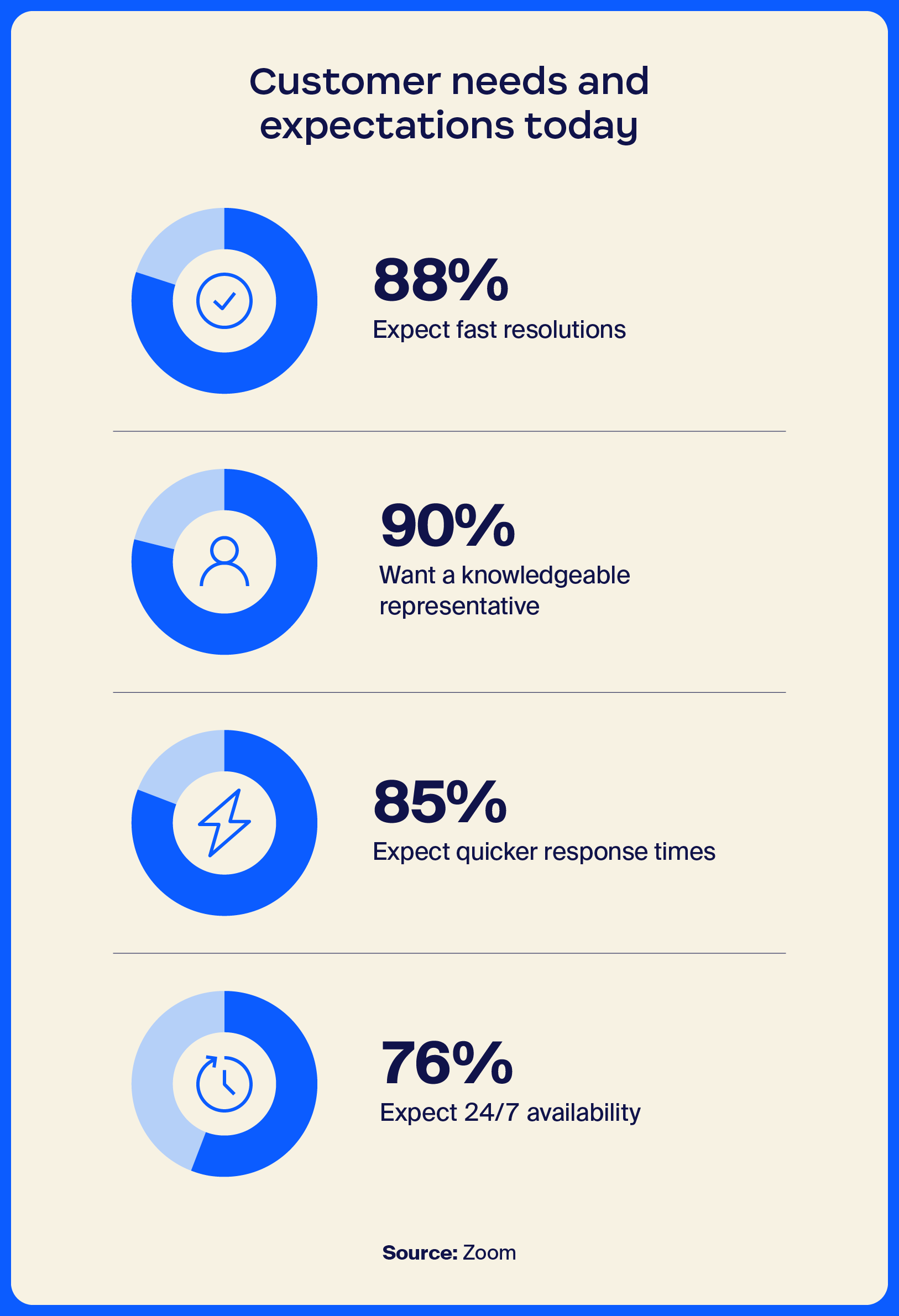
Customers want a personal connection, from the first interaction to troubleshooting and issue resolution. Recent research commissioned by Zoom and conducted by Morning Consult revealed that 89% of respondents expect agents to be friendly and 90% expect them to be knowledgeable. One of the current small business trends is building a system that balances human empathy with AI efficiency.
For example, AI can route customers to the right agent based on intent and summarize previous conversations so agents don't have to dig into old transcripts. Some CCaaS solutions, like Zoom Contact Center, include AI-assist features that guide agents across channels (voice, video, and chat) so they can quickly understand and resolve customer issues.
This is important because even as adoption rises, 33% of SMBs worry about bad or misleading information from AI.
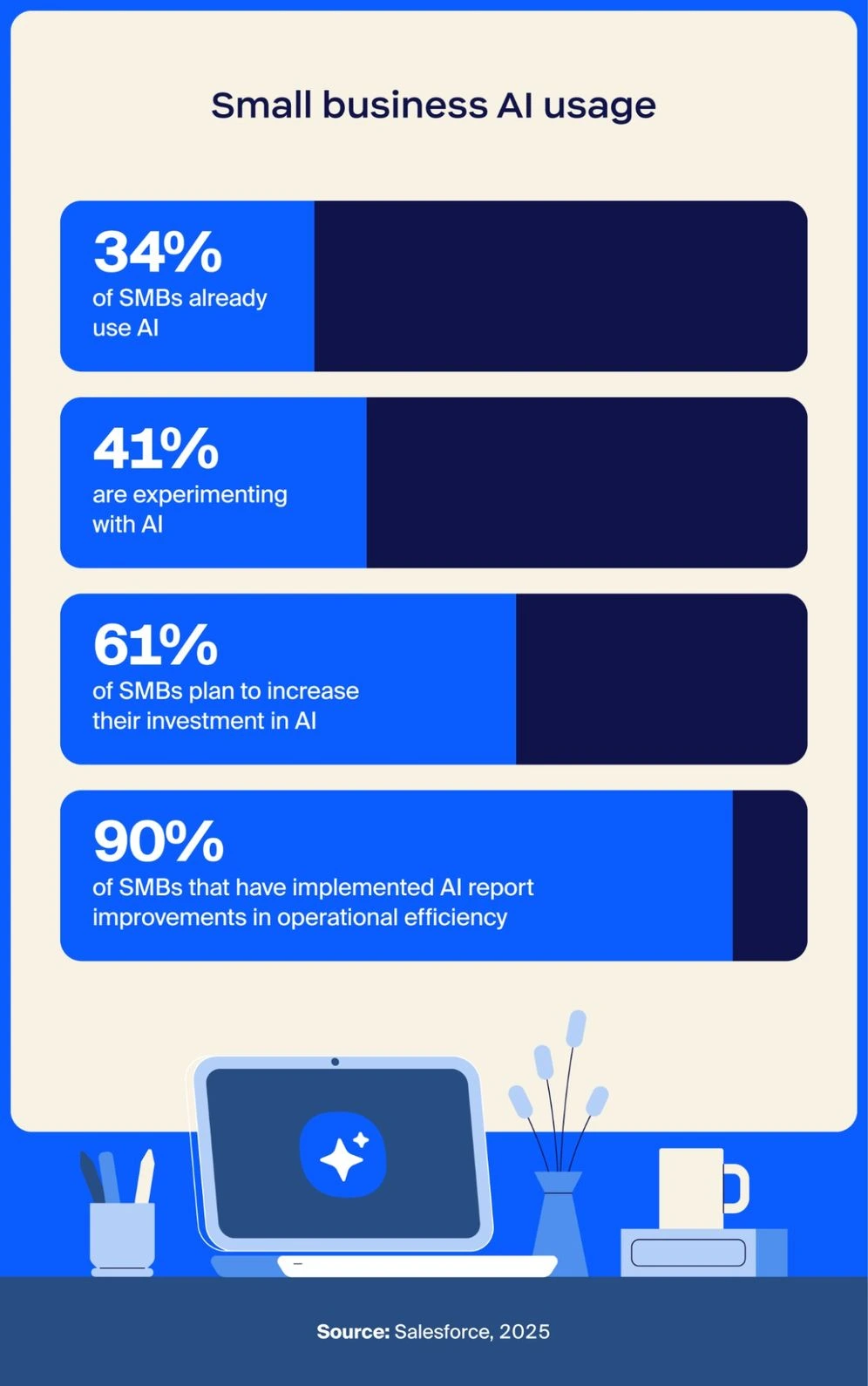
In recent years, the cost of AI technology has dropped significantly, making it more accessible to small businesses: A 2025 report by Salesforce says 34% of SMBs already use AI and 41% are experimenting with it. 61% also plan to increase their investment in AI over the next year.
This is likely because 90% of SMBs that have implemented AI report improvements in operational efficiency. Those efficiency gains often translate directly into better customer experiences.
And adoption is only accelerating as the cost of building with AI continues to drop. The hardware that's capable of handling AI functionalities is cheaper and more accessible than ever before. It's also important to note that flexible payment models offered by cloud solutions make it easier and more affordable for small businesses to break past the cost barrier.
Additionally, AI tools aren't as expensive to build as they used to be, with techniques like transfer learning — in which AI models draw on knowledge from pre-trained models — helping lower the overall cost of AI solutions.
The availability of affordable AI tools and platforms has made it easier for SMBs to experiment with and implement AI solutions. Cloud-based AI services like Zoom AI Companion offer a flexible, cost-effective way for businesses to access AI capabilities without a significant upfront investment.
Not long ago, small business team communication meant a siloed mix of phone calls, email threads, and a group chat that nobody could keep up with. Affordable, cloud-based unified communications changed that, making remote and hybrid work much more practical.
These days, UCaaS solutions give you everything from chat and video meetings to virtual whiteboards and file sharing in a single platform, providing a central hub for businesses to manage all their communication and collaboration.
On the customer side, cloud-based software has been just as impactful. CCaaS brings enterprise-grade omnichannel communications (voice, chat, email, and social) within reach of small- to medium-sized businesses that couldn't justify the infrastructure costs years ago.
This is probably why the cloud contact center software has grown rapidly in the last five years. (The market was valued at over $34.66 billion in 2025 and is projected to grow to $295.49 billion by 2035.)
Tech for small businesses goes beyond operational productivity and generative AI tools. Despite the growing threat of cyberattacks, many small businesses remain vulnerable to security breaches.
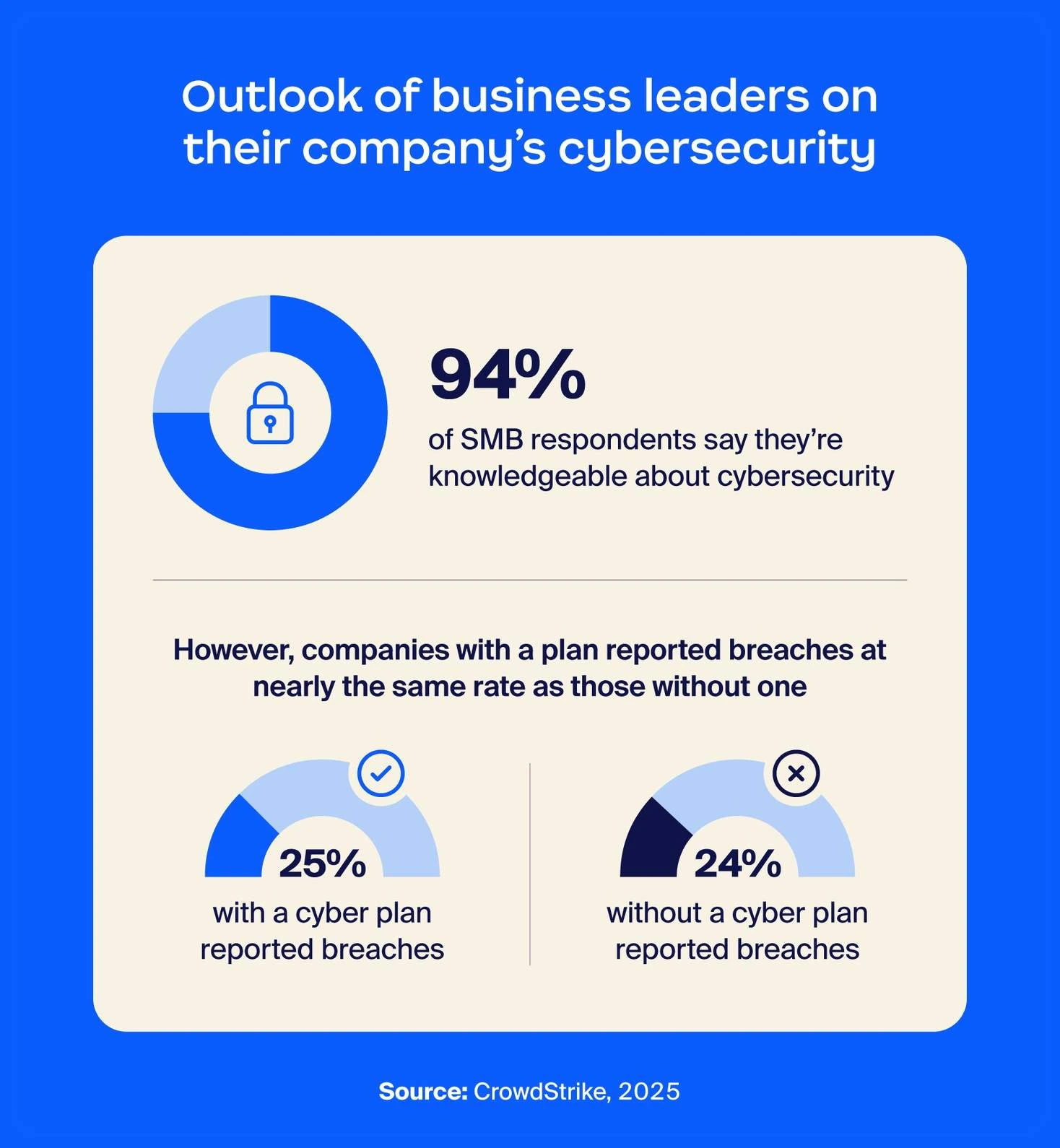
A 2025 CrowdStrike report shows that awareness isn't the problem. About 94% of SMB respondents say they're knowledgeable about cybersecurity threats, but many still fall short when it comes to executing their security plan. At the same time, companies with a plan reported breaches at nearly the same rate (25%) as those without one (24%). This indicates a significant gap between perceived security and actual preparedness.
Small businesses are particularly attractive targets for cybercriminals due to their often-limited resources and security measures. Attackers may exploit vulnerabilities in their IT infrastructure or employ phishing scams or social engineering tactics to gain unauthorized access to sensitive data.
As AI rolls into more workflows, that focus only grows — 29% of SMBs haven't implemented it because of security concerns.
The consequences of a cyberattack can be devastating for a small business, including financial loss, reputational damage, and operational disruption. It's essential for SMBs to choose communication and collaboration tools from trusted providers that prioritize cybersecurity and invest in measures to protect themselves from these threats.
The rise in remote and flexible work, along with the growing preference for cloud software, has made business communication tools and productivity technology a necessity.
In fact, the global team collaboration software market is projected to grow from $37.6 billion in 2026 to $52.26 billion by 2032.
Remote work demands that businesses have the right tech to help teams work together, even when physically apart. Tools like video conferencing, team chat, and project management software have become essential for maintaining productivity and fostering a sense of team cohesion.
We're also seeing tangible time back when AI is built into collaboration tools: one team reports saving up to 8 hours per week on meeting notes, while another cuts post-meeting wrap-ups to approximately 45 minutes.
For industries like retail and hospitality, where remote work is less common, technology for small business owners is critical for managing operations on the go. Unified communication software on mobile devices helps them keep necessary contacts, notes, and documents at their fingertips.
While the importance of customer-centric technology can't be overstated, many small businesses are prioritizing investments in operational efficiency tools. This reflects a focus on streamlining processes, improving productivity, and reducing costs.
According to a 2025 GTIA report, many SMBs spent the past year focusing their tech budgets on keeping operations stable (37%). Automation (19%) and addressing technical debt (13%) were also key priorities. One possible reason for this is that updating your tech stack lays the groundwork for adopting AI and other emerging technologies that can drastically improve efficiency.
So, while customer-centric technologies are valuable, SMBs may prioritize operational efficiency tools as a foundation for building a strong business before investing in stronger customer experience (CX) tools.
Economic sentiment among small businesses is mixed right now. The NFIB Small Business Optimism Index was 98.8 in February 2026. It's slightly above its 52-year average (98) but down for the second month in a row (it was 99.3 in January). This suggests owners are somewhat cautious about the broader economy.
At the same time, many businesses still appear confident in their ability to operate and grow. For example, 12% said they plan to create new jobs in the next three months.
While economic uncertainty persists, hiring demand among SMBs remains relatively strong. This suggests that while individuals may be apprehensive about the overall economic situation, they remain relatively confident in their own business prospects.
Hardware advancements are playing a crucial role in supporting the development and widespread adoption of AI.
"AI is already part of everyday work, and the next wave will make it feel even more natural. Smaller, more efficient models running on faster, lower-power chips will bring AI closer to the edge — more private, more responsive, and more affordable. That cost curve opens the door for simple, practical assists in the tools small teams use all day."
— Paul Celis, Product Marketing Manager, Small and Midsize Business at Zoom
Hardware vendors are beginning to develop AI PCs, adding neural processing units to the computer to support the graphics processing unit (GPU). For small business owners, this means equipment that is more performant and better suited to run AI applications. As the hardware systems supporting AI become more mature, this will also help reduce AI costs, making it more accessible.
The past couple of years have set the stage for an exciting future in small business technology. Collaboration solutions, customer support tools, and AI-first features are set to transform the workplace even more.
Due to rising operational costs, new regulations, and recent trends in customer expectations, sustainability is becoming a core part of business strategy for many businesses. As a result, sustainable technology is emerging as one of the latest small business trends. For many SMBs, investing in more energy-efficient systems and tools can be a practical way to manage costs and stay competitive.
Sustainable technology helps businesses save money and grow revenue by reducing energy use and waste. At the same time, many customers prefer to buy from eco-conscious brands. Research from McKinsey suggests that most consumers would change their habits to lessen their environmental impact, and brands committed to sustainability have grown much faster than others.
Small businesses can start with a few simple ideas that have a high impact, such as:
"When sustainability is viewed as being a matter of survival for your business, I believe you can create massive change."
— Cameron Sinclair, co-founder of Architecture for Humanity
Technology for small businesses is continually evolving, from the rise of AI and cloud software to the increasing demand for robust collaboration tools. For small to medium businesses, keeping up with these small business tech trends is essential for improving efficiency, meeting customer expectations, and maintaining a competitive advantage.
Zoom Workplace integrates your team's communication and collaboration tools into a single, AI-first platform. Discover how Zoom Workplace's integrated approach to docs, video meetings, and chat can help your business adapt to new challenges and prepare for future growth.
Small businesses need a well-structured tech stack that includes communication and collaboration tools (email, video conferencing, chat, project management software), customer relationship management software, accounting and financial tools, marketing automation tools, cybersecurity tools, and more.
A few small business tech trends that can impact you today are the growth of AI tools, the rise of cloud-based solutions, and hardware advancements to accommodate AI.
The critical technology for your business in the next six months will depend on your specific needs and goals, but some emerging technologies to consider include AI-first chatbots, search, and robust collaboration software.
An IT strategy is a roadmap that outlines a small business's technology goals and how to achieve them. It should include a technology needs assessment, budget allocation, security measures, and implementation plans.
Small businesses are frequent targets for cybercriminals, a risk now heightened by AI, which can create more sophisticated phishing and ransomware attacks. The expansion of remote work and cloud services introduces new security considerations for businesses. The modern work environment calls for continuous employee training to help protect against severe financial and operational disruption.
The most effective AI-powered platforms for small businesses are those that offer a suite of products to automate different daily tasks to enhance productivity, such as Zoom Workplace. AI assistants can help brainstorm, summarize documents, and take detailed meeting notes. AI-first search functions can save time by locating details across chats, documents, and transcripts.