



Meet Zoom AI Companion, your new AI assistant!
Boost productivity and team collaboration with Zoom AI Companion, available at no additional cost with eligible paid Zoom plans.
 5 min read
Published on October 16, 2025




If you want more leads and increased revenue, you've got to set yourself apart. But with plenty of competition and constant changes in the business world, how do you stand out?
Webinars are an excellent option. In fact, based on TwentyThree's research, 80% of companies polled said they're either increasing their webinar budget in 2026 or keeping it the same as in 2025, which is strong evidence of their effectiveness. Whether you want to engage more leads, share information, or simply raise brand awareness, webinars can help.
In this post, we'll delve into 42 webinar statistics that highlight why webinars are great for marketing. We have stats on key fields like webinar length, average webinar conversion rate, and average webinar attendance rate, so you can explore strategies for improving webinar attendance and hosting engaging and memorable webinars.
Webinars have become a tool for modern marketing and communication strategies. The following webinar stats outline the current webinar landscape and give you the knowledge to improve your efforts with some of the best webinar platforms.
Here are some general webinar stats:
With changing technology and increasing advances in AI, does webinar data show that webinars are still worth it in 2026? In short, absolutely.
Here are a few compelling data points that confirm our assessment:
12. The average live webinar attendance rate is 49%, meaning nearly half of registrants show up to watch. (Univid)
13. Total webinar attendance (including replays) reaches about 57%, showing ongoing engagement beyond the live event. (Univid)
14. Ninety-two percent of event professionals say improving post-event follow-up is a top priority for maximizing ROI. (Forrester)
15. Between 2025 and 2026, there has been nearly 20% growth in the number of organizations integrating webinars into their marketing plans. (TwentyThree)
16. Sixty-six percent of companies that create webinars say webinars are extremely or very important elements of their digital strategy. (TwentyThree)
17. Webinars have an average conversion rate of 63%. (TwentyThree)
Beyond the initial sign-up numbers lies the true test of a successful webinar: attendance and engagement. These metrics reveal how many registrants tune in and actively participate. Understanding audience behavior through key virtual event attendance statistics like webinar attendance and conversion rates allows you to tailor your webinars to resonate with your target group, maximizing their impact and achieving your marketing goals.
Here are some virtual event attendance statistics:
18. Forty-five percent of organizations have increased their annual webinar frequency from the previous year. (TwentyThree)
19. Thirty-one percent of marketers report maximizing engagement as a top challenge in their webinar strategy. (Kaltura)
20. Forty-one percent of marketers strive to improve networking and engagement in their webinars. (Kaltura)
21. Marketers find that analytics dashboards (48%) and networking and engagement features (41%) are lacking in webinar technology. (Kaltura)
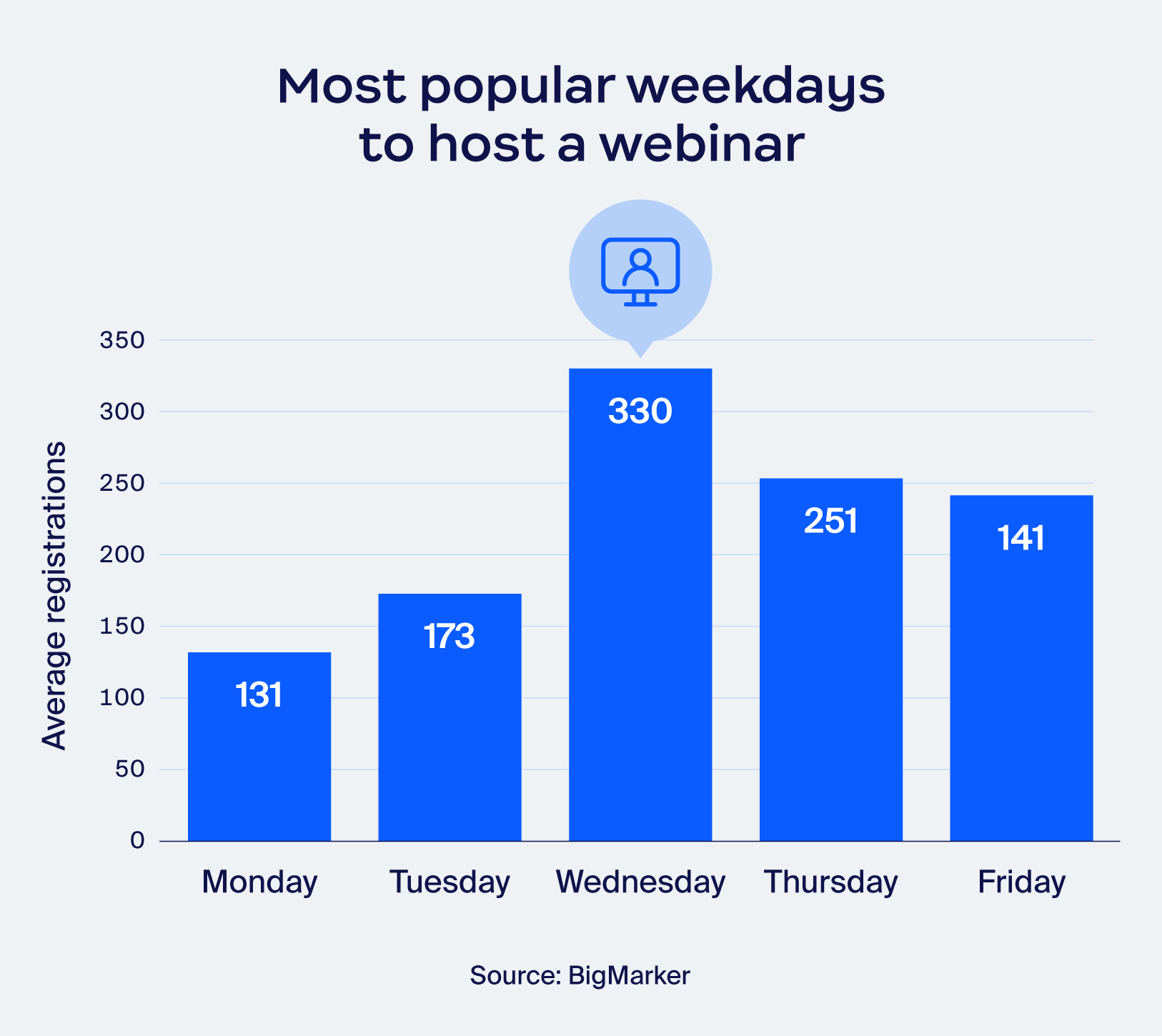
22. Most webinars take place from Tuesday to Thursday, with Thursday having the highest webinar attendance rate (64%). (TwentyThree)
23. The best time of day to host a webinar is between 11 a.m. and 2 p.m. (BigMarker)
24. Nearly half (49%) of marketers use engagement analytics to refine their marketing strategies, while only 20% leverage it for lead scoring. (Kaltura)
25. Eighty-nine percent of webinars are standalone or one-off events, with 45% episodic and 24% recurring. (TwentyThree)
26. Only 2% of organizations are effectively using webinars for relationship building, resulting in untapped potential. (TwentyThree)
27. The average open rate for webinar invitation emails is 1.7x higher than general marketing emails. The average click rate is 4.5x. (BigMarker)
28. The ideal webinar length is 30 to 60 minutes, with most high-performing webinars falling in the 45-minute range. Shorter sessions (under 30 minutes) tend to see lower engagement, while sessions over 60 minutes risk drop-off. (BigMarker)
The power of webinars varies across industries. Some sectors rely heavily on them, while others favor different delivery methods. Delving into industry-specific webinar statistics sheds light on which fields are most active in this space and how content themes differ.
Here are some industry-specific webinar stats:
29. One analysis showed that the industry with the highest attendance rate is pharmaceutical (50%), while the lowest are software and services (28%), diversified capital markets (20%), and education services (20%). (Banzai)
30. Sixty-seven percent of organizations creating webinars use them to educate customers and improve their experience, with lead generation coming in second at 65%. (TwentyThree)
31. Sixty-five percent of marketers repurpose webinar content, which is a time-saving, money-saving, and audience-building tactic. (Kaltura)
32. Startups with under $1 million in revenue see half the attendance rate of companies with $1 million to $10 million in revenue. (Banzai)
33. For marketers, 24% report that webinars are their most important tool and play an important strategic role. (Kaltura)
34. Twenty-five percent of webinar-creating organizations plan to spend more on webinars going forward, with 55% planning to spend about the same amount. (TwentyThree)
35. The virtual events industry is expected to reach a value of around $1.03 trillion by 2032, at a compound annual growth rate of about 14% between 2023 and 2032. (Custom Market Insights)
36. Marketing teams use webinars the most (85%), with sales (71%) a close second. The lowest use comes from design (9%) and HR/recruitment (8%). (TwentyThree)
Webinars are no longer simple online presentations. The key to unlocking their potential lies in conversions — turning viewers into active participants who take the next step in their journey with your brand.
Here are some webinar benchmarks related to conversion:
37. Webinars attract an average of 308 sign-ups, with a 58% attendance rate. (TwentyThree)
38. The average conversion rate of live webinars is 63%, and the average on-demand conversion rate is 19%. (TwentyThree)
39. The average webinar conversion rate of webinar CTAs is 22%, meaning roughly 1 in 5 attendees take the desired next step after the event. (Univid)
40. Having 2 CTAs gets you maximum conversion (25%). (Univid)
41. Webinars with 50-100 attendees see the highest CTA conversion rates, averaging 26%. (Univid)
42. Fifty-two percent of marketers say first-party data improves targeting and personalization, both key drivers of higher conversion rates. (Content Marketing Institute)
Webinars are one of the few marketing formats that combine reach, engagement, and measurable impact in a single channel. They help you connect with motivated audiences, build trust faster, and create content that keeps working long after the live session ends.
Webinars work so well for marketing because they:
If you're exploring practical webinar marketing tips, the biggest takeaway is simple: Webinars capture attention and hold it long enough to build real momentum. When done right, they support both short-term pipeline goals and long-term audience growth.
Zoom Webinars is designed to help you move beyond basic presentations and deliver structured, engaging experiences that audiences actually remember. Whether you're hosting Zoom Meetings or Zoom Webinars, you can scale participation, manage interaction, and maintain a professional environment from start to finish.
With Zoom Webinars, you can create immersive online experiences that drive knowledge sharing, collaboration, and dynamic audience interaction. And when you're ready, you can go bigger and upgrade your single-session virtual events with Zoom Webinars Plus to support multi-session programming, deeper engagement, and stronger brand experiences.