


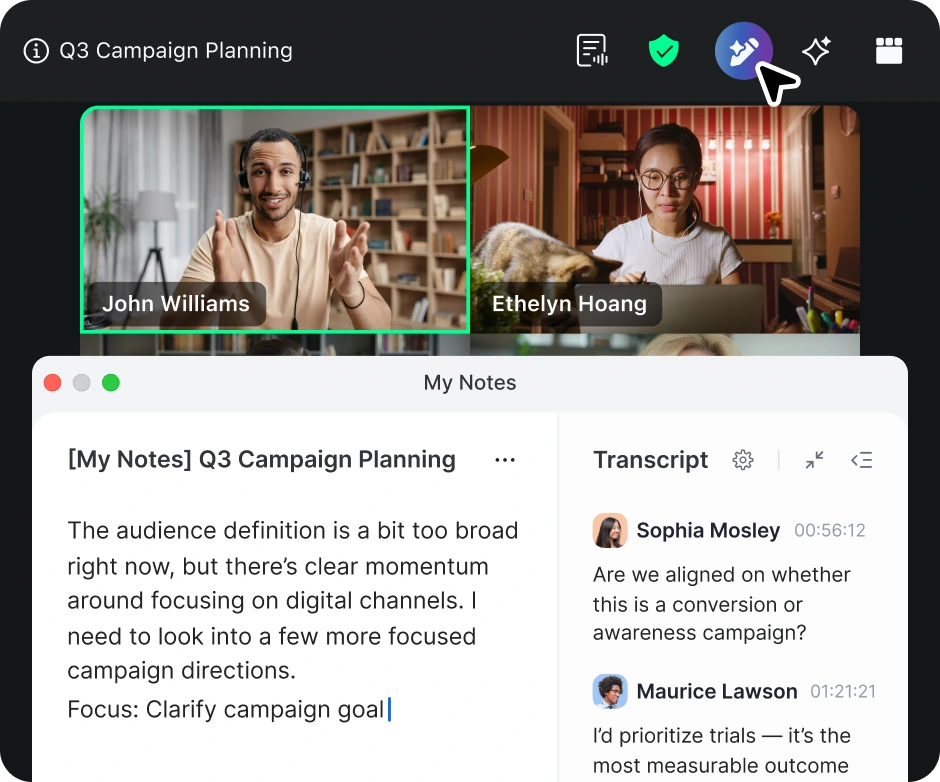

Meet Zoom AI Companion, your new AI assistant!
Boost productivity and team collaboration with Zoom AI Companion, available at no additional cost with eligible paid Zoom plans.
 7 min read
Published on April 28, 2026




Work doesn't just happen at a desk anymore. It happens between meetings, on job sites, in hospital corridors, and on the train. Your teams are already making business calls from their mobile phones — the question is whether your teams can actually see it.
For most organisations, the answer is no. And that gap is growing.
Here's what happens when mobile calling sits outside your business phone system.
The most obvious challenge is visibility. Employees use personal numbers for client calls. IT has no insight into who's calling whom, or when. Compliance teams can't capture, archive, or monitor conversations happening outside the office. And when mobile data connectivity drops, call quality suffers.
But compliance is only part of the picture. Even when regulatory requirements aren't the primary concern, there's a deeper problem: if most of an employee's conversations happen through the native dialer and SMS app rather than through Zoom Phone, those interactions aren't connected to Zoom's AI. Zoom AI Companion can't summarise a call it was never connected to. It can't extract next steps from a conversation that happened outside the Zoom platform. The more work moves to mobile, the less complete the picture becomes — and the less value AI can deliver.
The result is a patchwork of workarounds. Personal numbers standing in for business lines. Separate carrier contracts alongside your UCaaS platform. Compliance gaps that grow wider every time someone takes a call from a car park. And an AI strategy with a blind spot at the exact place where more and more work actually happens — on the phone, on the move.
For IT and telecom leaders, it creates a familiar headache: fragmented communications across devices, limited control over mobile activity, incomplete AI context, and no clean way to bring it all together.
Zoom Phone Mobile is designed to close that gap. It extends enterprise-grade calling to the mobile phone's native dialer, using the cellular network rather than Wi-Fi or cellular data connectivity. This way, employees can make and receive business calls the way they already make calls. No new app to download. No training to roll out. No change to how people work.
Behind the scenes, IT gets what matters most: simplicity and control. One business number follows employees across their devices, on mobile, desktop, and desk phone. One admin portal manages users, numbers, policies, call recording, and compliance settings.
One compliance framework covers voice and SMS — recording, retention, and monitoring — whether the call happens at a desk or on the move. And because AI is built in, every Zoom Phone Mobile call can come with automatic summaries and next steps, so the conversation that happened on the go doesn't get lost before someone's back at their desk.
For organisations managing the complexity of separate carrier contracts, reimbursement programmes, and multiple admin portals today, the maths is straightforward: one bill, one number, one device, one provider.
Zoom Phone Mobile is available now in the UK, with US availability coming later in 2026.
The challenge of unmanaged mobile calling looks different depending on the industry — but the underlying problem is the same. Here's how Zoom Phone Mobile can help address it across four key sectors.
Advisors and client-facing staff in financial services often rely on mobile devices for day-to-day communication — but they're working under strict regulatory requirements for call capture, archiving, and identity management.
Zoom Phone Mobile can help address this by enabling mobile calling and SMS compliance right in the Zoom Phone ecosystem. Calls and texts via Zoom Phone Mobile are captured centrally, with audit logs and governance managed from a single admin portal. And AI-generated summaries can support documentation and follow-up — without requiring advisors to take manual notes between meetings.
No second device. No workaround. Just business calling that's designed to support compliance from wherever work happens.
Clinicians, care coordinators, and administrative staff regularly take patient calls from outside the office — between wards, from home, or while moving between sites. Reliable connectivity matters, and so does protecting the business number.
Zoom Phone Mobile uses the cellular network rather than Wi-Fi or cellular data, so calls can stay clear even in areas without Wi-Fi or with poor data coverage. Business number identity is protected, giving patients a consistent point of contact without exposing personal numbers. And IT gets centralised visibility into mobile calling activity across the organisation.
For healthcare teams balancing patient communication with operational complexity, it's designed to keep things simple — reliable calling, protected identity, one place to manage it.
Field engineers. Property managers. Logistics coordinators. Construction supervisors. These are people who are rarely at a desk — and who depend on mobile phones to keep projects moving and customers informed.
Zoom Phone Mobile gives them a native dialer experience with no behaviour change required. Calls use the cellular network for reliability. Business numbers are protected, so personal numbers stay private. And IT manages everything centrally — users, numbers, policies — without needing to chase down individual devices.
For organisations with large mobile workforces, it's a way to bring structure and visibility to calling activity that's been invisible until now.
Solicitors and client-facing legal professionals handle sensitive conversations throughout the day — often from outside the office. Whether it's a call taken between court appearances or a quick follow-up from a taxi, these interactions often need to be documented and attributable to the firm.
Zoom Phone Mobile can help by keeping business calls within Zoom Phone, with optional call recording and business number identity protection as standard. AI summaries* support record keeping and follow-up, reducing the need for manual notes. And because everything runs through the native dialer, there's nothing new to learn — solicitors just call the way they already call.
*Zoom will not use your information to train its own models or allow third-party-models to be trained on your models. Read more about Zoom’s Commitment to Responsible AI.
Other approaches to mobile business calling tend to start with an app — download it, learn it, switch to it. Zoom Phone Mobile starts with the phone employees already have and the dialer they already use.
It's not a standalone tool. It's an extension of Zoom Phone — the same platform, the same admin portal, the same policies — brought to mobile. That means:
For IT leaders evaluating mobile calling options, the question isn't just "can our employees make calls?" — it's "can we see, manage, and secure those calls the same way we do everything else?" Zoom Phone Mobile is designed to answer that question with a "yes".
Zoom Phone Mobile is available now in the UK. If you're looking to simplify your mobile calling, reduce shadow IT, and give your teams reliable business calling from wherever they work — we'd love to talk.
Zoom Phone Mobile is currently available in the UK, with US availability planned for later in 2026. Devices will need to be carrier unlocked. Features and availability may vary.